London shows that fine-grained street networks outperform mega-blocks. High intersection density creates redundant parallel routes. Redundant routes let pedestrians choose quiet over loud without going far.
In late August 2026, walking in London, I repeated a simple move. I stepped off a loud thoroughfare, moved one street over, and continued the same walk in relative quiet. The distance was short, yet the shift in sound and social texture was immediate.
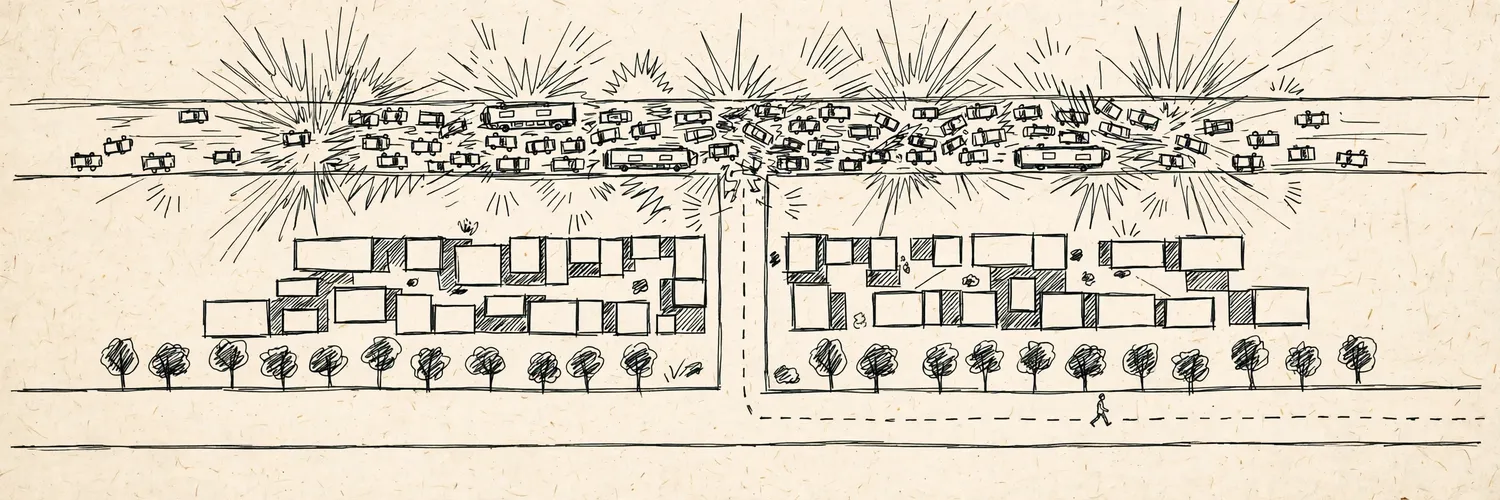
When I mentioned the move, the responses were protective. One joked, "Ssssshhhhhhhh. Don't tell the tourists." Another described a childhood memory of slipping off a busy London street into a quieter one with family. The tone was protective, like locals guarding insider knowledge.
The STS lesson here is co-production, not technological determinism. The street network does not simply carry movement. Planners, developers, residents, and technologies of movement co-produce what kinds of social life are possible alongside movement.
London and the American mega-block represent two different settlements of that co-production. London retains a medieval and early modern grain in many districts. Streets are narrow. Blocks are short. Intersections are frequent. A pedestrian can adjust a route by one block and find a different acoustic and social register. This is not the whole of London. The Barbican and parts of Docklands show that London also built mega-block schemes. The fine-grained pattern I describe is specific to districts where the historic network survived.
Hillier and his colleagues at UCL gave this pattern a measure: integration. A street is more integrated when it can be reached from the rest of the network with fewer changes of direction. Configuration predicts movement. More integrated streets carry more movement. Less integrated streets carry less. In a fine-grained district, that difference can appear within a block. The thoroughfare takes more of the load because it connects more directly. The parallel street remains connected enough to use, but it sits off the main lines of movement.
Hillier and Shinichi Iida tested that sorting in London in 2005. In a cross-sectional configurational analysis, they compared metric, topological, and angular measures of network distance against observed pedestrian and vehicular movement in four inner London areas. Topological and angular measures fit observed movement better than metric distance. The better measures counted changes of direction and accumulated turning, not only length. The grid therefore does not distribute movement evenly. It sorts movement by configuration.
The American mega-block is a product of a different era and a different theory. Between 1949 and 1974, urban renewal reshaped more than 1,200 American cities and towns through an interlocking set of national and local policies. Programs targeted the eradication of areas deemed slums or blighted, often to socially sanitize neighborhoods inhabited by racial minorities, and over 25 years they destroyed more affordable housing than they created. Renewal agencies and the developers working at their scale found large parcels easier to assemble, easier to model, and easier to finance. The cost was paid in pedestrian choice and in displacement.
Owen Gutfreund traces the parallel highway history. In 2004, he published Twentieth-Century Sprawl with Oxford University Press. He shows how government policies subsidized roads, destabilized cities, and left state and local governments with large highway bills. The publisher summary states that those policies "subsidized the spread of cities and fueled a chronic nationwide dependence on cars and roadbuilding, with little regard for expense, efficiency, ecological damage, or social equity." When blocks grow large and through streets disappear, the pedestrian loses the parallel option. The arterial becomes the only path.
Jane Jacobs named the alternative in 1961. She published The Death and Life of Great American Cities with Random House. She argued against the rationalist planning of the 1950s and against large-scale urban renewal. She proposed four conditions for vibrant districts. Districts need mixed primary uses. They need small blocks with dense intersections. They need buildings of varied age and form to support a mix of low-rent and high-rent tenants. They need sufficient concentration of people and buildings. She also supplied the concept of the border vacuum. Large single-use elements drain activity from their edges. A mega-block functions as a border vacuum. It consolidates parcels, reduces through streets, and forces pedestrians onto the arterial.
The empirical literature gives this contrast a quantitative base.
In 2010, Reid Ewing and Robert Cervero published a meta-analysis of more than 200 studies on travel and the built environment in the Journal of the American Planning Association. The analysis pooled results across density, diversity, design, destination accessibility, and distance to transit. The abstract states: "Walking is most strongly related to measures of land use diversity, intersection density, and the number of destinations within walking distance."
Population and job density were only weakly associated with travel behavior once other variables were controlled. A dense district built at mega-block scale can underperform a fine-grained district with the same floor area. The paper defined design to include average block size, the proportion of four-way intersections, and intersections per square mile. Those measures describe the London pattern in quantitative terms. They also explain why density alone misleads. A tower surrounded by a superblock can be dense and still hostile to walking. A mid-rise district with small blocks and frequent intersections can be less dense on paper and far more walkable in practice.
In 2015, Hyungun Sung, Sugie Lee, and Sanghyun Cheon tested Jacobs with data from Seoul. The study appeared in the Journal of Planning Education and Research. It translated her four conditions into measurable variables. It tested those variables against travel data with multilevel binomial models. The abstract reports: "Employing multilevel binomial models, we empirically verified that Jacobs's conditions for urban diversity play a significant role with regard to pedestrian activity."
Small blocks promoted walking. The team measured this as short distance from a building to a street corner. That measure captures the geometry of stepping one street over. Mixed uses and aged buildings added to the effect. Housing diversity mattered. Proximity to rail and parks mattered. The effects varied by time of day, which matches the Jacobs claim that vitality comes from overlapping uses across hours. Large-scale developments, arterial roads, and on-ground rail suppressed walking.
Why the parallel street is quieter takes two steps. The first step is sorting. Hillier's configuration work predicts that movement will concentrate on the more integrated streets and thin out on the streets a block away. Less traffic should mean less noise. That step alone does not say how large the drop can be, or how quickly it can occur.
The second step is at the building face. Timothy Van Renterghem and Dick Botteldooren studied the quiet-side effect in dwellings highly exposed to road traffic noise in Flanders. Their study included 100 dwellings. A dwelling lacked a quiet façade when the difference between its most and least exposed sides was smaller than 10 dBA. Those dwellings had an odds ratio of 3.3 for at least moderate annoyance compared with dwellings that had a quiet façade, after adjustment for residents' noise sensitivity. The absence of a quiet side therefore tracks a substantial rise in reported annoyance.
Bodin and colleagues found the related pattern in Malmö. In a survey of 2,612 residents, access to a quiet side was associated with an odds ratio of 0.47 for noise annoyance compared with residents without that access, with a 95 percent confidence interval of 0.38 to 0.59. Access meant at least one window facing a yard, water, or green space. Comparing their results with Dutch findings, the authors suggested that block structure may matter. They described Malmö's open blocks as buildings strung along a road, while closed blocks shelter from all sides. They called the supporting evidence for that explanation anecdotal. The block-form step is therefore their conjecture, not their measured finding. Building designers and the planners who approve their plans decide how many dwellings receive a shielded side; residents whose windows all face the traffic bear the noise.
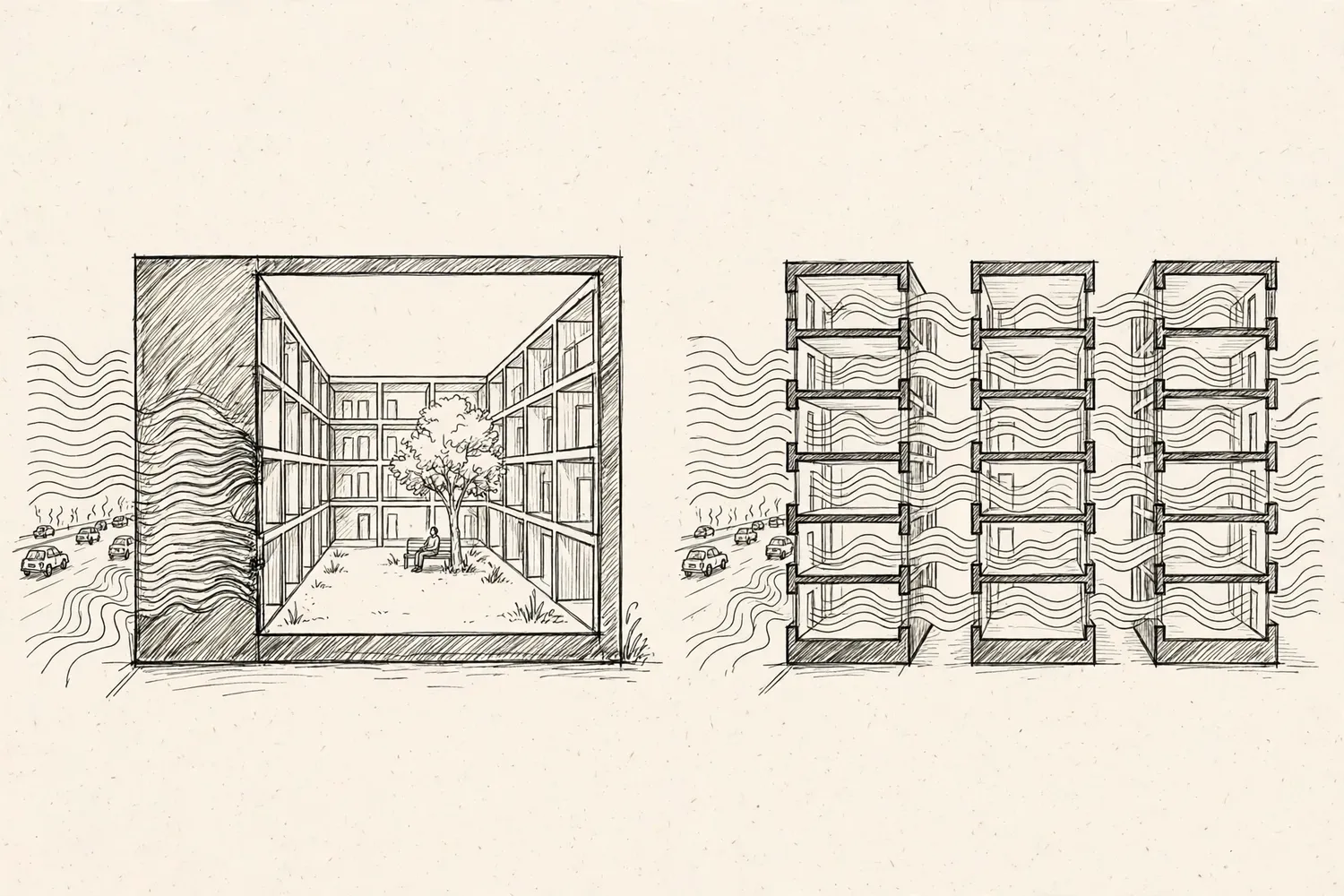
Put the two steps together. Grain sorts the traffic. Block form gives some dwellings a sheltered side. Hillier measures movement, not decibels. The acoustics work measures façades and reported annoyance, not networks. I am the one welding them. The weld is my claim that the same fine grain does both jobs. It sorts movement unevenly, and it makes the sheltered side available within a short walk. What I have not found is a study that measures both ends on one set of streets: the traffic sorting and the paired-street decibel drop, in the same district, tied to grain. That is the study that would settle it, and it is the one I want to see.
In Livable Streets (1981), Donald Appleyard reported a comparison of three similar San Francisco streets carrying 2,000, 8,000, and 16,000 vehicles per day. Residents of the light-traffic street reported roughly three times as many friends and twice as many acquaintances as residents of the heavy-traffic street, counting friends and acquaintances who lived on the respondent's own street. Home territory shrank as traffic rose. Some residents of the heavy street described their apartments as invaded by the sound of cars. A Bristol replication in 60 households confirmed the pattern.
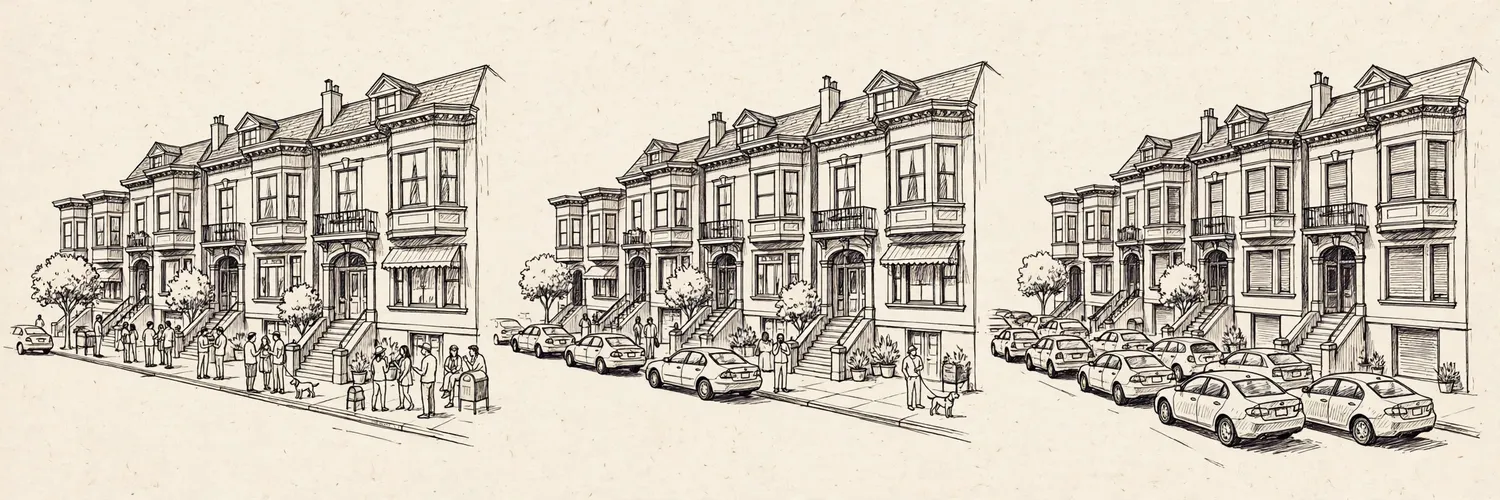
Appleyard helps explain why the fifty meter move matters so much. Traffic does more than slow walking. It contracts social territory. It reduces the number of people a resident knows by name. It changes the home from a place that extends into the street to a place that defends against the street. London works where its historic grain survived because that grain separates traffic from social life without requiring distance. The thoroughfare carries the load. The parallel street stays quiet enough for conversation. The network offers choice through redundancy. Many American mega-block districts offer a single loud route. They separate uses, widen arterials, and leave the pedestrian with fewer options.
The value at stake is human agency in the city. The criterion is simple. Maximize meaningful choice per step. Three contentions follow.
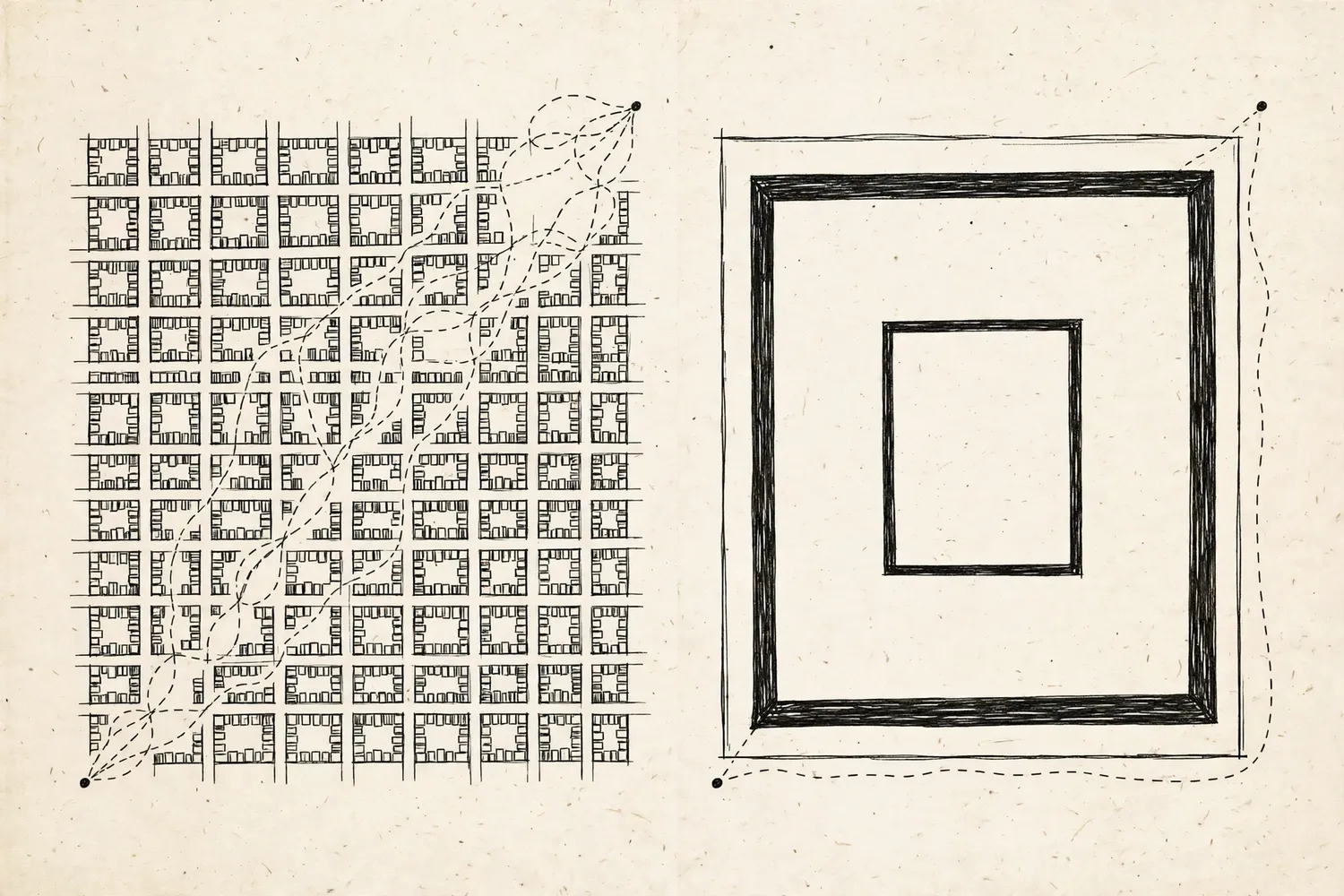
First, choice improves walkability. More intersections create more parallel routes. More parallel routes give pedestrians a choice. The Ewing and Cervero meta-analysis supports this mechanism. Intersection density is among the strongest correlates of walking. When a pedestrian can adjust a route by one block, walking remains viable under varied conditions. Heat, noise, construction, or a crowded sidewalk can be routed around. The mega-block removes that adjustment.
Second, choice protects social life. Appleyard shows that traffic volume predicts social connection. The Seoul test shows that small blocks predict pedestrian activity. Together they describe a system. Fine grain lets traffic concentrate on a few streets while social life continues one block away. That concentration is not costless: the residents of the carrying street bear the traffic that makes the quieter street possible. Coarse grain forces traffic and social life onto the same street. People withdraw. They spend less time on the sidewalk. They know fewer neighbors.
Third, choice builds resilience. A single optimized corridor fails under load. A fine-grained network absorbs it. This holds for traffic. It holds for construction detours. It holds for economic change. Small blocks support small storefronts. Small storefronts turn over faster than large single-tenant parcels. Jacobs made this point about aged buildings. Older, smaller buildings offer lower rents and more experimentation. The Seoul data confirms the mechanism.
Product leaders can apply the same criterion. Teams often optimize the main flow and instrument the thoroughfare, yet they neglect the parallel street. The pattern is familiar. A team builds one onboarding funnel. It tunes that funnel. It adds instrumentation to that funnel. It forgets to build alternative paths for different intents, different contexts, and different levels of urgency.
Resilient products need redundant paths at fine grain. Redundancy means a lattice of small, connected options rather than a single corridor with branches. In practice this looks like several things. It looks like multiple entry points to the same capability. It looks like quiet defaults alongside powerful advanced paths. It looks like small, composable surfaces rather than monolithic pages. Choice per step can be measured. Track the share of sessions that use a non-primary path to completion. Track recovery rate after a primary path failure. If those numbers are near zero, the network is a corridor, not a lattice.
The organizational parallel is direct. In 1968, Melvin Conway published "How Do Committees Invent?" in Datamation. Fred Brooks later named the thesis Conway's Law. The original claim states that "organizations which design systems (in the broad sense used here) are constrained to produce designs which are copies of the communication structures of these organizations." The nuance matters. Conway describes communication structure, not the formal org chart. Two teams that talk constantly function as one. One team split across time zones functions as two. Organizations with dense lateral communication produce modular designs. Organizations with few lateral ties produce monoliths.
Resilience research supports the same point. In 2021, Sooksan Kantabutra and Nuttasorn Ketprapakorn published a theory-building paper on organizational resilience in Sustainability. They argue that under strain, informal networks form alongside formal hierarchy, as an enhancement to it. Their summary states: "In a crisis, knowledgeable organizational members self-organize into ad hoc networks to offer expert problem solving... The informal latent networks are in place only when organizations encounter a disturbance and quickly develop contingencies as an enhancement to the normal formal organizational structure with rigid roles." The fine-grained city and the fine-grained organization share a mechanism. Redundant lateral ties absorb load that would break a single corridor.
Two caveats keep this honest. Hillier and Iida give the traffic-sorting step a London-specific test, but I found no London-specific study of the whole step-one-street-over phenomenon. The sources above generalize beyond London. The Ewing and Cervero meta-analysis pools largely North American studies. The Sung test uses Seoul data. The mechanisms travel, but the specific urban history does not. I also found no study directly linking street-network granularity to measured noise levels. Appleyard links traffic to noise intrusion and to social life. That link sits one step removed from granularity itself. A future study could measure sound levels on paired parallel streets in London and test the fifty meter claim directly.
The next question is practical. If fine grain outperforms coarse grain, how does a city or a company retrofit toward fine grain once the mega-block exists? The street network is durable. Parcels are harder to subdivide than to assemble. Products face a similar lock-in. A monolithic page is easier to ship than a lattice of small surfaces. The work ahead is to identify the smallest interventions that restore choice. In streets, that can mean mid-block passages, new crosswalks, or breaking a superblock with a pedestrian-priority lane. In products, that can mean adding one quiet parallel path and measuring whether users take it. The principle holds in both domains. Start with choice per step, and let the network do the rest.